Last Updated on 12 June 2026 by Colette
This post contains affiliate links. As an Amazon Associate I earn from qualifying purchases.
Planning a family holiday in France comes with a fairly big decision: how are you actually going to get there? You have three main choices – flying, hopping on the Eurotunnel or taking a ferry – each comes with its own benefits (and a few drawbacks) so the answer isn’t always as clear cut as you might think!
To help you choose the right option for your family, I’ve pulled together the pros and cons of all three.
We have been holidaying in France as a family for around ten years now and in that time we’ve tried various modes of transport, routes and destinations – we’ve even recently experimented with hiring a car for the journey rather than taking our own vehicle. We almost always travel in May half term as it’s so much cheaper and quieter than going to France in the summer holidays and until now we have always taken our own car.
Plenty of people question the sanity of driving all the way to the south of France for a week but honestly, if you want sunshine at that time of year then you need to be in the South. Last year we saw plenty of people holidaying in the North for May half term who had weather which was much the same as at home – and to be honest, rain isn’t what I’m going abroad for.


Flying to France
If you’re heading to the south of France or want to minimise travel time, flying can be the quickest and most convenient option. Every time we start to plan a holiday to the south of France, we considering flying but typically, for the five of us, we find the cost ends up being prohibitive in comparison to driving. Beyond the cost implications, there are of course benefits and negatives to flying to France.
Benefits of Flying
- Fastest travel time making it ideal for reaching places like the Côte d’Azur, Provence or the Alps in just a couple of hours.
- Lots of airport choices across the UK and France, making routes flexible.
- Great for northern families who’d otherwise face a long drive to the south coast to access the ferry or tunnel (oh hello, that’s us!)
- Potentially good value, especially out of season or mid-week (which tends not to be the case for us as we are still bound by school holidays)
- No long drives or seasickness worries which is obviously a big plus for some children (and adults!)
Negatives of Flying
- Airports can be stressful with kids: security queues, waiting around, and keeping everyone entertained.
- Extra costs for baggage, seat selection and sports equipment.
- Flight cancellations and delays can cause major disruption, especially during peak seasons adding stress and stealing precious hours of sunshine. If you do find your flights cancelled, AirHelp can advise on how to claim compensation for this. If you do end up stuck at the airport dealing with delays or cancellations, you’ll probably be using the airport Wi-Fi to rebook or check updates, so it’s worth having a VPN to keep your payment details and personal information secure on public networks.
- You’ll need transport when you land, meaning car hire or using public transport – this is a really big consideration for our family as our holidays in France are typically self-catered campsite holidays with the likes of Eurocamp so being able to stock up at the local supermarket or explore nearby towns is a big part of our holiday (in fact last time we took a day trip over the border into Italy!)
- Less flexibility overall as you’re obviously tied to the airline’s timetable and proximity to airports if you don’t want to add a lot of driving at the other end.

LeShuttle (Eurotunnel / Channel Tunnel)
The Eurotunnel is often the favourite choice for families who want speed, convenience, and the ability to take their own car. We switched from the ferry to the tunnel a few years ago and haven’t looked back.
Benefits of the LeShuttle
- Fastest route for taking your car – just 35 minutes from Folkestone to Calais making it great if you want to continue your adventure into neighbouring countries like Spain, Italy or Germany (don’t forget check out options for an eSIM for Germany and beyond if that’s the case!)
- You stay in your car the whole time, making it super easy with kids, teens, or pets – Dave and I use the time in the tunnel to try and catch a nap.
- There are no baggage limits – if you can fit it in your car you can take it so you can pack the car with everything from scooters to inflatables (until now we’ve always taken the kids bikes on the bike rack too though we don’t plan to do that next year as they’re all so much bigger now).
- The Eurotunnel has a flexible departure system, meaning you can often board earlier or later which takes the pressure off if you’ve under or overestimated how long the drive will take or have got stuck in traffic.
- Perfect for road trips or holidays where having your own vehicle matters (e.g. camping, Eurocamp, skiing).
Negatives of the Eurotunnel
- Peak-time prices can be high, especially during school holidays – we find travelling a day early makes a big difference to cost if you can manage it and we always use our Tesco Clubcard vouchers to help to pay for the tunnel.
- The drive to the terminal can be long for families in the North or Scotland – we have found driving through the night to Folkstone is the best traffic wise but it does mean that we then arrive in France having already lost a night’s sleep and tired. In previous years we have left around tea time when the kids got home from school, this year we set off in the afternoon to maximise our natural waking hours if that makes sense?
- Traffic delays around the terminal aren’t uncommon in the summer – not just heading to the terminal but coming back as well. There’s nothing worse than getting off the Eurotunnel after a long drive up France to then sit in traffic back in the UK!
- No driving break – you go straight from UK roads to French ones. (We don’t especially mind this – Dave usually does the first stint in France as he’s more used to driving abroad then I am and then we take it in turns for the rest of the trip).
- The flexible departure system that I mentioned as a bonus can also have downsides as last time we travelled to France we weren’t allowed on the train we were booked on as it was full leaving us with a frustrating couple of hours wait for the next train.
Ferry to France
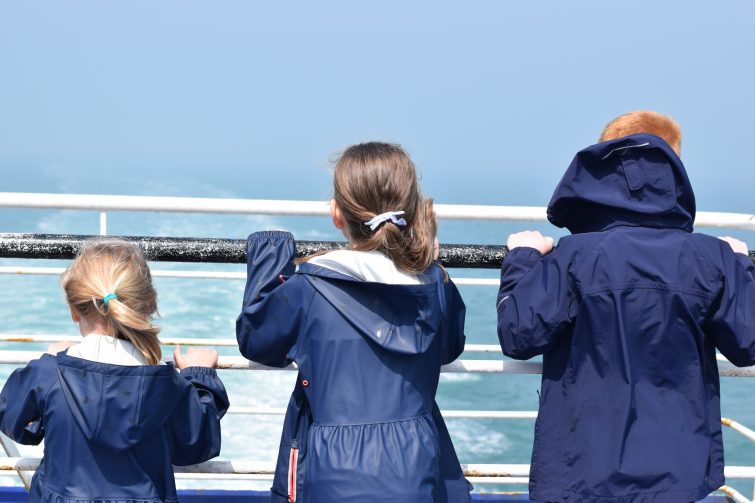
If you like the idea of your holiday starting the moment you leave the port, ferries offer a more relaxed, spacious way to travel.
Benefits of Travelling by Ferry
- The ferry is often a calmer, more enjoyable experience for families: space to move, restaurants, cafes, open decks, and kids’ play areas.
- Take your car, and bring as much luggage as you like (again this can include bike racks and roof racks or even your caravan!)
- Lots of UK departure ports including Dover, Portsmouth, Poole and Plymouth – handy depending where you live. We typically chose to get the ferry from Dover as my Aunty and Uncle used to live there giving us a handy overnight stop to break up the drive. We have also done the Plymouth to Roscoff ferry but found it to be really hard work having driven down to the port through the night – the kids were really young so couldn’t just go off on their own and we hadn’t booked a cabin. If we were to take that route again now I think it would be much easier as the kids are so much more independent.
- Overnight crossings allow everyone to sleep onboard, saving on accommodation and hopefully meaning you arrive in France well rested. (As someone who is quite claustrophobic, the idea of sleeping in a cabin does not appeal!)
- Great for kids who love the novelty of being on a ship.
Negatives of Travelling by Ferry
- Slower than both flying and the Eurotunnel – even the Dover to Calais service takes a minimum of 1hr 30 mins which is about three times as long as the tunnel.
- Weather can affect crossings, leading to delays or cancellations.
- Costs can rise if you need a cabin or travel during peak periods.
- Sea sickness may be an issue for some family members. (That would be me – I find sea sickness tablets really help but leave me feeling drowsy which isn’t great when you’ve got a long drive ahead!)
- Arrival ports may require longer onward drives, depending on your destination.
So… Which One Should You Choose?
Every family is different, so the best way to travel to France depends very much on your holiday style:
Choose flying if… you want to reach southern France quickly, prefer shorter travel days, or live far from southern ports.
Choose the Eurotunnel if… you want to take your own car, appreciate flexibility, and prefer to avoid airports or open water.
Choose the ferry if… you like a chilled start to the trip, want the kids to burn off energy during the journey, or enjoy overnight crossings.

France is wonderfully easy to reach from the UK, and each route has its advantages. Flying suits long-distance adventures, the Eurotunnel is ideal for fast and fuss-free family travel with a car, and ferries offer a relaxed and spacious alternative.
Whichever way you choose, planning ahead – especially if you are travelling during school holidays – will help you get the best prices, smoothest journey, and the least stress for everyone involved.
You can read more about holidays in France here:
Our guide to family holidays in France

If you have enjoyed this post and found it helpful, here are a few ways you can say thanks and support We’re going on an adventure:
Click here to buy me a virtual coffee – it’s like a little tip jar but with caffeine!
I’d love for you to tag me in any photos of your adventures on Social Media if one of my posts has inspired you to visit
Click here to leave We’re going on an adventure a Google Review
Share this post with your friends – you’ll be helping me and them!
Follow We’re going on an adventure on Facebook or Instagram